


Educational and diverse Reproduction Symposium at the KWPN Stallion Show
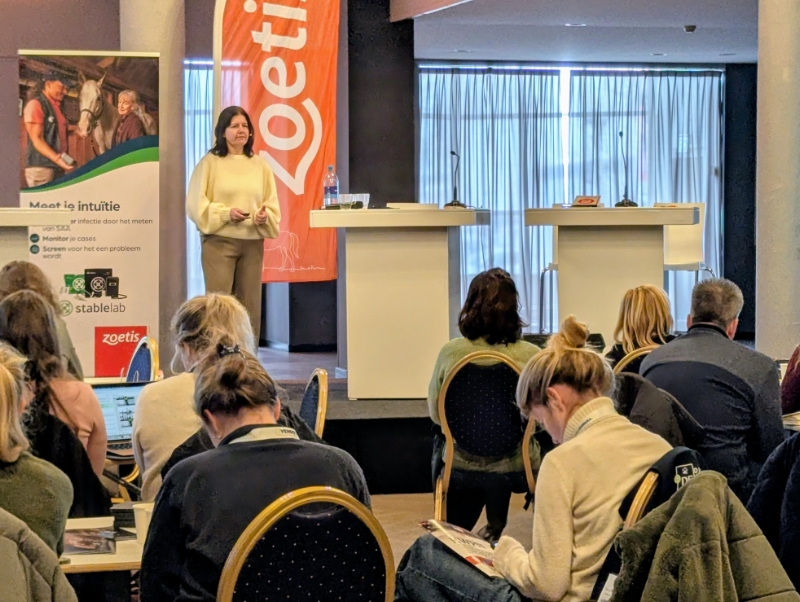
On Thursday 29 January, the KWPN Reproduction Symposium powered by Zoetis took place during the KWPN Stallion Show. This reproduction symposium was designed for, and strongly supported by, veterinarians. National and international experts shared their experience and discussed the latest developments in equine reproduction.
One of the speakers was Belgian veterinarian Jan Govaere from Ghent University. He spoke about the wide variety of foal births and pointed out that excessive human pulling force during foaling can cause serious injuries. “Use no more than two people to assist and apply traction at the correct position on the foal’s legs. Do not pull for too long and switch to plan B after fifteen minutes. Even after the birth of a healthy foal, it is essential to remain alert and ensure that the placenta is expelled within three hours; otherwise, veterinary assistance should be called in.” He also recommended the Vetflix Academy, a new website launching within a few weeks that will provide accurate anatomical visual material.
Tailored treatment
Mathijs Theelen, specialist in Equine Internal Medicine at Utrecht University, also took the floor. He spoke about common and varied respiratory infections in foals, such as bacterial pneumonia and problems related to a poor swallowing reflex. He also highlighted incorrect bottle-feeding techniques: while human babies are fed with the bottle held upwards, doing the same with a foal, head and neck extended, can cause milk to enter the lungs. Feeding from a bowl held in front of the foal is a safer method and can be taught within a few days. “Rhodococcus equi pneumonia also occurs regularly in slightly older foals. On some breeding farms it appears more frequently due to various factors, and a tailored treatment approach is recommended to prevent future problems.”
Developments and successes
Marion Papas, from Equine Reproduction Service and assistant professor of Equine Health Care, guided the audience through the historical development of reproductive techniques. “In 1978, the first IVF baby was born. By the mid-1980s, embryo transfer had become common practice in cattle. In horses, this took several more years and proved to be much more challenging. Today, both IVF and ICSI have developed rapidly, with increasing success rates. Research has shown that semen quality plays a decisive role in these techniques.”
A highly educational day
Leanne van de Goor of VHL Genetics, although not a veterinarian, shared extensive knowledge about equine genetics. She explained hereditary traits, as well as genetic diseases and abnormalities that can occur in horses. For example, Turner syndrome can cause infertility in mares. Certain coat colours, such as Appaloosa, are associated with the gene for night blindness, while the Frame Overo pattern can be linked to blue eyes and the Lethal White Syndrome.
Many other interesting topics were discussed throughout the day. Karin Hendriks, European Specialist in Equine Reproduction, concluded the programme with clear guidelines on equine reproduction. The symposium was organised in cooperation with Dier-N-artsen and Lingehoeve Oost-Nederland and proved to be a long but highly educational and valuable day.
Text & photo: GJ for KWPN
















 KWPN Database
 KWPN.tv
 KWPN Horses for Sale