


Rebecca Dudley: “Big movers are not always top horses”
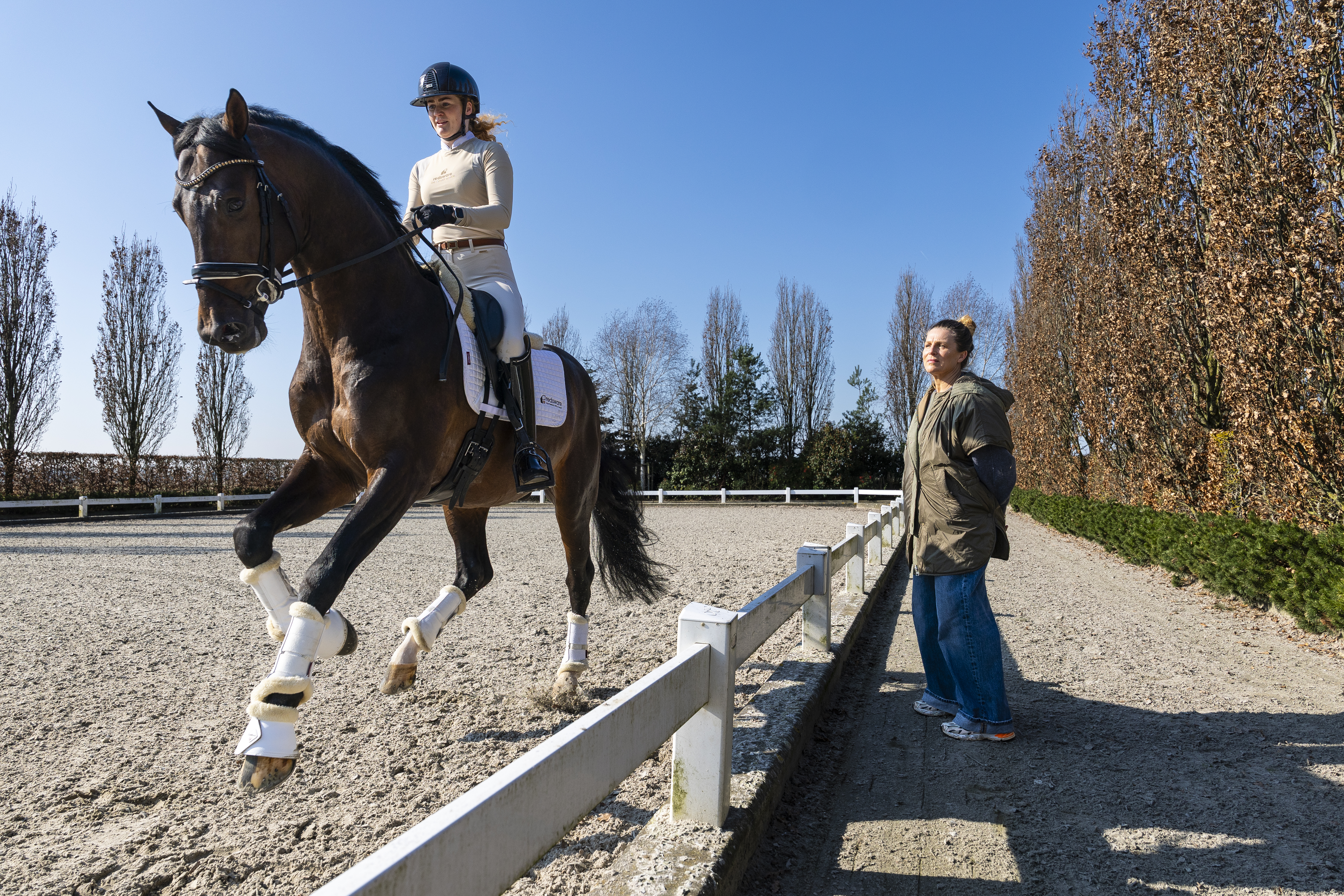
Living in the city center, without having a private stable, yet successfully building a breeding program while also running a thriving dressage horse sales agency: British-born Rebecca Dudley does it all. During the most recent KWPN Stallion Show, she had two stallions selected for the performance test, one of which, Thanks a Million (by Desperado), was also awarded a premium.
“Breeding is actually a hobby”, Rebecca Dudley says with a smile. It is, however, a hobby she takes very seriously—and one that has already brought considerable success. This year, at the KWPN Stallion Show, the stallion she bred, Thanks a Million (Desperado out of Santana van Hof Olympia elite sport-dres pref prest PROK D-OC by Sandro Hit), co-registered with Yvon Kaptein and MT-Stables, was awarded a premium. She also had her homebred Toronto (Bonds out of Gita A elite pref IBOP-dres PROK by Jazz), co-owned with Paardencentrum De Dalhoeve, selected for the performance test. Two years ago, Dudley also bred the premium stallion Rockstar Millionaire (by D’Avie). This half-brother to Thanks a Million is now co-owned with Yvon Kaptein and Stal Witte Scholtens, and is ridden by Emmelie Scholtens.
No own facilities
Dudley lives in the center of Leiden and runs her equestrian business through various collaborations. “What I do may be a bit unusual, but it works”, she laughs. She works closely with Yvon Kaptein of De Vrijhoeve, as well as with Marcel and Tamara van Manen, Nol Gerritsen, and others. Not having her own facilities is something she actually sees as an advantage: “Because I’m not tied to one location, I get to see a lot out in the field. I travel a lot with clients and see many horses. I see offspring from all stallions, let my clients ride them, and observe how they respond. I attend veterinary inspections weekly, so I also gain insight into the health of different bloodlines. That gives me an advantage over people who have their own facilities and everything at home, but rarely leave their yard. You learn a lot by observing.”
It was never Dudley’s intention to end up working professionally with horses. She was born in Great Britain, with a Dutch mother and a British father, a naval officer who passed away at a young age. She was raised speaking English and, due to her father’s work, lived across Europe as a child. Dudley was always passionate about horses and learned to ride Welsh ponies in Cornwall. She continued riding until she went to university in London to study fashion.
After graduating, Dudley moved to the Netherlands, her mother was living there again, and life in London had become too expensive as a recent graduate. She initially planned to stay temporarily, but during a winter sports holiday in the French Alps she met a Dutch man. She ended up staying in the Netherlands and never left. They have now been together for 25 years and have two children, neither of whom are involved with horses.
De Vrijhoeve
Once in the Netherlands, her passion for riding returned, eventually leading her fully into the horse world. She worked at a fashion company, and on her daily commute she would pass riding school Xenophon in Hazerswoude-Rijndijk. “After a while, I just went in and asked if I could ride. Within three months I had my own horse, with which I competed in eventing and showjumping”, Dudley says with a laugh.
At the time, she occasionally competed at nearby De Vrijhoeve, where she met Yvon Kaptein, the owner of the stable. Soon after, she moved her horse there, and gradually her work in horse trading began. “A friend of mine from England, Hannah Biggs, called to ask if I knew a suitable Junior dressage horse. I started asking around. And once you start asking in the Netherlands, things move quickly, everyone seems to know something. Normally I was working in an office, so when I spent two days traveling with them to look at horses, I thought: this is actually really fun.”
Starting in horse trading
Dudley sought advice from various people on how the horse trade works. “I quickly learned that I should charge ten percent commission, and I still stick to that. Hannah bought that horse, and once she got home, she told others about it. Word spread quickly that I could find horses in the Netherlands. They also appreciated that I spoke good Dutch, which allowed me to communicate well with Dutch owners and check everything properly.”
Gradually, Dudley learned more and more about horse trading. “I started from scratch and hardly knew anyone here. I had to learn everything myself, which also meant making mistakes. Over time, I became better at filtering and learned more about dressage horses.” She also sought advice from experienced professionals. “For example, Ad Valk. I often encountered him in the trade, and I admired how he built his business from the ground up. I listened carefully to him, as I did with others of his caliber. I asked them how they did things. Horse people love talking about horses, so if I ask, ‘How did you find Apache?’, all I have to do is listen.”
Changing market
Now that she has been in the business for about eighteen years, Dudley has seen the market change. At the moment, she finds trading quite difficult, particularly when it comes to the veterinary aspect. “Veterinarians and inspections have become a challenge, sometimes almost impossible. Vets are sometimes even hesitant to make certain statements. When I first started, people bought horses based on just a clinical exam or a set of fourteen X-rays. That no longer happens today.”
According to Dudley, the overall expectations of clients have increased. “The horses have improved significantly over the years, but I think the level of riding has declined. People are less daring and are trained differently than in the past. I hardly ever see a client ride away better on a horse than the horse’s own rider.”
Thanks to the internet and social media, clients find Dudley much more easily. However, if she does not see a suitable match, she is not afraid to say no. “Sometimes expectations exceed riding ability. I want to be honest when I don’t believe in a sale. If I’m out with a client and I see that riding is proving difficult, I’ll often schedule other horses to try that same day. It really has to be the right match.”
Selling from video
Dudley does occasionally sell from video, but only when she has a very good feeling about both the horse and the client. As a rule, she wants to have seen every horse she sells in person, including those located abroad. She sometimes finds it challenging that everyone nowadays wants to see a video beforehand. “Videos are often completely different from how a horse is in real life. It happens frequently that clients decide not to view a horse based on the video. If I believe it could be a match, I will often still include that horse in the schedule. And very often, that ends up being the horse they buy. That’s why trying a horse yourself is so important.” She also notices that many clients are drawn to horses with the most impressive trot. “Even though clients say that a good walk and canter are important, they usually focus on the trot.” In the end, however, that trot is rarely the reason a horse is purchased: “The horses I sell most easily are the ones that are the nicest to ride. People buy the horse that gives them the best feeling. It’s not about spectacular movement, but about a good feeling. I’ve developed an eye for that over time, and it can also depend on a horse’s bloodlines or its riders.” According to Dudley, honesty is the most important thing. “Don’t hide anything. There’s no point. If there is something with a horse, people will find out anyway. Every horse has something.”
Spectacular movement
Dudley is convinced that young horses do not need to be extravagant movers. “Those big movers do not always turn into top horses later on. I prefer them to be correct and sound, with a good type and, above all, rideable. As a breeder, aim to produce a rideable and healthy horse. Foals that trot in an extremely spectacular way don’t mean much to me. Our best horses were not outstanding trotters as foals at all.” Because of rideability, Dudley is particularly fond of Desperado bloodlines in her horses. “They produce very rideable horses, and especially very kind ones. That is so important for the sport, and I also believe a horse should be rideable enough that you can always sell it.” Dudley also sees the rising costs in breeding and sympathizes with the average breeder: “It’s becoming increasingly difficult. But if you want to sell a homebred horse well later on, they are best properly backed and placed with a good rider. Of course, that costs money, but the better you position a horse, the better it is trained, the easier it will sell.”
From buying foals to breeding herself
That is also what Dudley aims to achieve with her own breeding program: producing pleasant, rideable horses. Around eighty percent of the horses are bred together with Yvon Kaptein of De Vrijhoeve. Because Dudley sees so many horses while traveling, she initially felt the urge to buy a foal herself. “It started without any commercial intention. I came across many nice yearlings and foals on the road, and I often said to Yvon: ‘Shall we?’ Eventually, we moved from buying foals to breeding ourselves. And that is mainly a hobby. I enjoy trading, but it can be tough. That’s why the horses you have in your own stable need to be enjoyable.”
Dudley usually breeds between three and seven foals per year. Producing that number of foals also brings another challenge: once they are raised, they need to be backed. Dudley and Kaptein handle the early stages themselves, such as halter training and lunging. “I do the first bridle and saddle myself, and also lean over them for the first time. Only when they are truly ready to be backed do we move on to the next step. I really enjoy ‘playing’ with the horses like this, you get to know them even better after having known them from day one. Yvon keeps an eye on things when I’m away, but ideally we would also have a rider. Now we have to outsource everything, and that is a major expense”, Dudley explains. She is very pleased with the collaborations she has within her breeding program. “I have to work together with others because I don’t have my own facilities. I also don’t have the time to teach all the horses everything myself. I really enjoy working with others, we can all focus on what we’re good at and benefit from each other.”
Investing in good mares
Dudley considers good mares essential for breeding. “If I come across something I like, I will always buy it. I don’t mind taking a risk. If you want to breed good horses, it all starts with very good mares.” For Dudley, ‘good mares’ are not necessarily mares with many predicates. “We also have younger mares without predicates, but they all come from strong dam lines, true sport lines. All our broodmares have been ridden; they also need to be pleasant, rideable horses under saddle. We don’t always present them for inspections or IBOP tests, as long as we know for ourselves that they are good sport horses. I mainly look at sport, type, and soundness.”
Health in breeding is something Dudley finds challenging, especially with new or young mares. “You only really know what you have after a few years. If the first foal of a mare later turns out not to be correct on X-rays, you may already have bred foals from her in the following two years. If a mare produces foals that are not healthy enough for several years in a row, we stop breeding with her. If they’re not healthy, they’re not marketable. For example, we have an older broodmare that is a very nice, well-bred horse, but we were not convinced by her foals. She is now a recipient mare, and she does that fantastically.”
Two successful mares
Dudley has had great success with two mares: the exceptionally tested Gita A (by Jazz), who scored 91.5 points in the IBOP, and Santana van Hof Olympia (by Sandro Hit). Dudley initially owned Gita A together with Nol Gerritsen of De Dalhoeve. When Gerritsen decided to scale down his breeding activities, Dudley took over the mare together with Marcel and Tamara van Manen from Kootwijkerbroek, where Gita A is now also based. “Gita is a special mare with a lot of blood. She had a short but good career under saddle”, Dudley explains.
Gita A is also the dam of the KWPN stallion New Orleans (by Farrell) and Toronto, the Bonds son who was selected this year for the performance test. “Toronto has just been started under saddle, and we are preparing him for the performance test. He’s a stallion that will be very exciting under saddle. I also think his pedigree will be very interesting for Dutch breeding.” Together with Marcel and Tamara van Manen, Dudley also has a Vitalis son out of Gita and a foal by her own stallion Rockstar Millionaire out of Gita.
A few years ago, Dudley was able to purchase the stallion-producing mare Santana van Hof Olympia (Sandro Hit, bred by H.J.C. & I.J.W. Poettgens-Deckers). Santana sadly passed away two years ago due to PPID. Dudley had come to know Berend Minnen of Resim Dressage through trading. “I visited there regularly and knew this line well, as well as the horses it produced. When Berend became ill, he eventually had to sell his horses. That’s how it started.” Together with Marcel and Tamara van Manen and Yvon Kaptein, Dudley acquired the mare. “Santana gave us many foals and truly had a wonderful life.” A notable detail is that all foals bred by Dudley have ‘Million’ in their name. “When we bought this mare, we jokingly said: ‘This mare will make us millionaires.’ So we gave all the foals names that included ‘Million’.”
From Santana, they bred, among others, the second-round approved stallion New Millionaire (by Desperado), who was sold after the first selection. The premium stallion Rockstar Millionaire (by D’Avie) also comes from Santana and is still co-owned by Dudley, Emmelie Scholtens, and Yvon Kaptein. When Santana’s health declined, she still produced three more offspring through ET and ICSI: two by Desperado and one by Indian Rock. Dudley hopes to continue breeding with the Indian Rock mare to preserve this line; she will be prepared for mare inspection in the coming season.
From hobby breeder to the Brabanthallen
Dudley mainly determines the stallion choices for her own mares together with the co-owners of those mares. Her experiences in the field play a major role in these decisions. “I see a lot, and along the way I notice which stallions pass on which traits, whether it’s rideability, correctness, or soundness. I base my stallion choices on that.” Whether a stallion has already proven himself at the highest level or is still relatively young does not matter much to her. She focuses on the characteristics of both the stallion and the mare, as well as the traits their bloodlines tend to pass on.
“I enjoy breeding with something different from the stallions that are commonly used in the Netherlands. For example, when Nol Gerritsen was selecting for the Borculo auction, he came across many good foals by Bonds, which led us to breed Gita with Bonds. That resulted in our selected stallion. In Denmark, I recently saw several very good Quaterhit offspring, I thought they were fantastic. That’s why I bred with Quaterhit last year, and we now have a very beautiful foal from that.”
What started as a hobby has grown into a fairly serious business. Dudley smiles: “But in a fun way. I think all of our homebred stallions will become incredibly good sport horses. I really enjoy being part of this process. With the truly good horses, I’m in no rush, if the costs allow it, I prefer to keep them.” Watching the foals grow into sport horses is what Dudley enjoys most: “I can’t wait for this year’s foals to be born. I know them from day one, and it’s amazing and very special to see those same horses a few years later standing in the Brabanthallen.”
Source: Bettine van Harselaar
Photo: Leanjo de Koster*
















 KWPN Database
 KWPN.tv
 KWPN Horses for Sale