


Leon Thijssen: No compromises on attitude, quality, and soundness
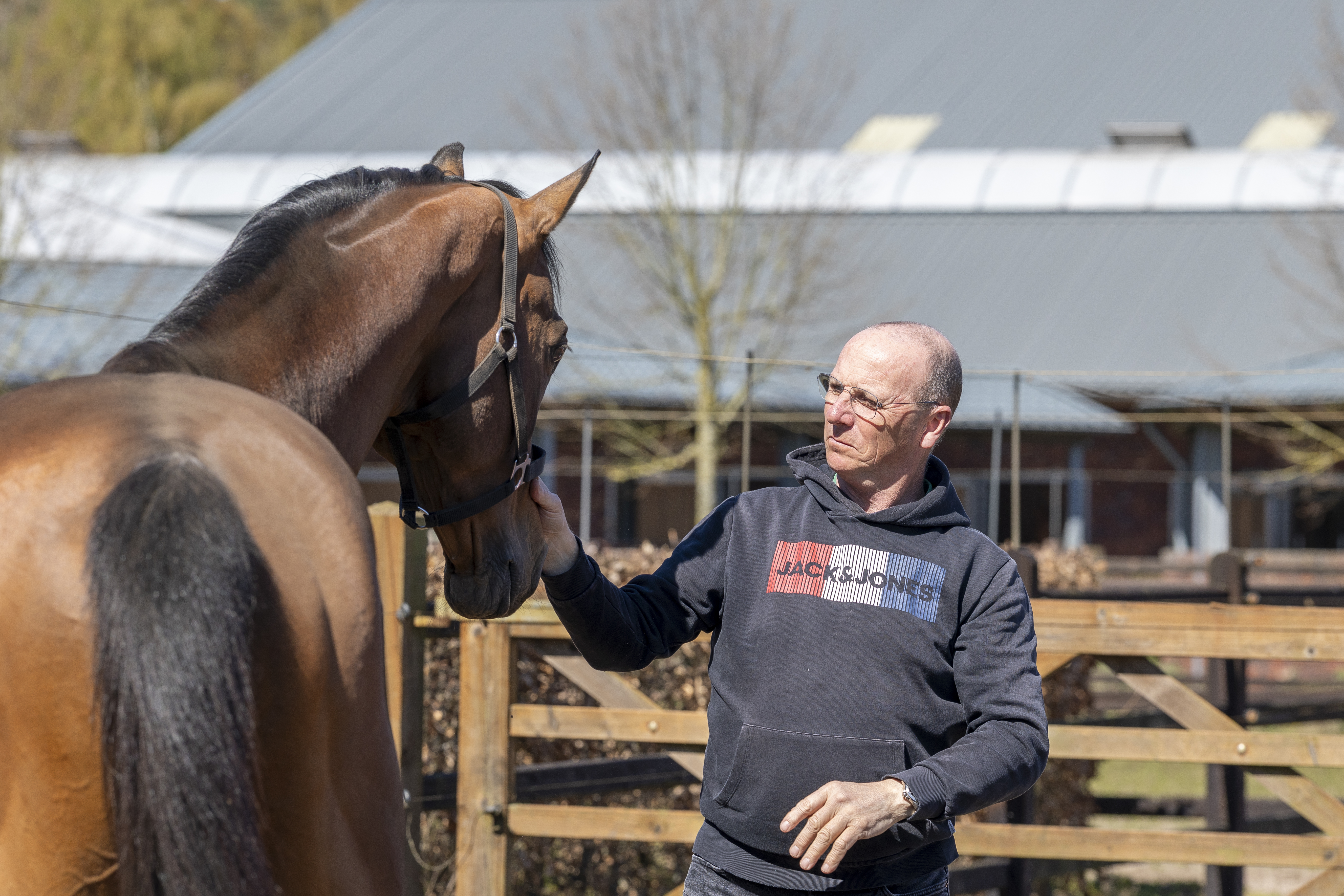
Leon Thijssen is a perfect example of a modern breeder. His passion for breeding originated from the sport, and by now his breeding program largely serves his sport stable. Several of his breeding products have already developed into 1.60m showjumpers, such as Hello, Juice, and Hi There. The common thread in his breeding story? Never compromising on attitude, quality, and the health of his mares. And that approach is paying off.
The international showjumper from Sevenum can already look back on a successful sporting career at the highest level and has also more than proven himself as a “father of,” as a trader, and as a breeder. Together with his wife Dorien and their three children, he has built a fantastic family business that demonstrates its value at the highest level in sport and now also in breeding.
Feeling and horsemanship
The Thijssen family has been based at their current location in Sevenum since 2015. Daughter Mel (25) and son Mans (23) both work at the stable, while eldest daughter Sanne (27) runs her own sport stable at another location. Together, they uphold the family name at the highest level, and in this collective top performance, mother Dorien also plays a major role. Although Leon himself only started riding at a relatively late age, as a self-taught rider he has managed to continuously improve both himself and his horses, steadily raising the bar. In 1996, Leon competed in a Nations Cup for the first time, and in 2005 he was part of the Dutch team that won bronze at the European Championships in San Patrignano with Nairobi (v.Larno). In 2008, he sold Nairobi and, with Olaf (v.Concorde), became the reserve combination for the Olympic Games in Hong Kong. Four years later, he fulfilled that same role with the stallion Tyson (v.Numero Uno) for the Olympic Games in London. All of these were horses he had discovered himself at a young age. When it comes to breeding, it quickly becomes clear that all his experience as a rider is of enormous value. In fact, Leon’s breeding instinct is entirely based on the feel he has developed as a rider and scout. And that nose for quality has proven itself time and again. At a young age, he not only discovered his own top horses, but also standout performers such as Voyeur (s.Tolano van ’t Riethof), Uceko (s.Celano), and of course the 18-time Grand Prix winner Con Quidam RB (s.Quinar), who will be discussed in more detail later.
Instant success
Back to breeding. What started with a few sport mares has grown into a serious branch of the business, with around 25 foals expected this year, the first of which have already been born. “It started on a small scale, but over the years I deliberately began keeping mares for breeding after their sport careers.” Leon’s very first breeding product immediately developed into an international 1.60m showjumper. This Wupp was the result of pairing Colino, a stallion bred by Martien Liefhebber, for whom Leon rode several horses at the time with the international sport mare DBH Granata (s.Grosso Z), who was highly successful at the top level with, among others, Peter Geerink. She won the Grand Prix of Helsinki in 1997. The combination of a stallion Leon himself has great confidence in and a mare that has first proven herself extensively in sport has continued to bring breeding success to the Thijssen family in the years that followed. After one foal in 2003, one in 2004, and one in 2005, Leon bred two Tyson offspring in 2006, including Tyson Uno ( out of Izaura G stb sport-spr by Grosso Z). “That dam had first jumped World Cups with Roelof Bril and later also with me. After her sport career, I used her for breeding; Tyson Uno was her first offspring, and she had him at the age of sixteen.” In 2007 (3), 2008 (2), and 2009 (2), several more foals were bred, but the first ‘larger’ crop followed in 2010. “That year we bred six foals, and now we’re up to 25,” Thijssen laughs.
Third Grand Prix horse
Among the best horses from the 2010 crop is the Je t’Aime Flamenco-son Flesh, who competed at the highest level under the name Rising Son with Irish rider Michael G Duffy. “We bred that horse out of Super Girl, a daughter of Navarone whom I sold to Kent Farrington and who jumped top-level classes in the United States. She later returned, and we bred several offspring from her. Coincidentally, her most recent offspring even won among the seven-year-olds this April at the international show in Peelbergen Equestrian Centre.” This refers to the Hello-son Of Course, ridden by Mans Thijssen. After a small crop in 2011 (1), seven foals followed in 2012. From that group, Hello and Hi There (Nabab de Rêve out of Unorette by Numero Uno) are competing at 1.60m level, while Huppeldepup (Tyson out of Close Up by Lord Z) developed into a 1.45m showjumper. Huppeldepup is a granddaughter of the previously mentioned Grand Prix mare Granata and is now fully dedicated to breeding at Leon’s stable.
Attitude
Using international sport mares in breeding brings several advantages. Mares with a successful sport career have proven both their quality and their soundness, and another benefit is that Leon knows the mares well. This allows him to make very targeted stallion choices. “The most important decision is that I truly only want to breed from mares that I consider good enough as sport horses myself. From the very beginning, I have used mares that possess attitude, quality, and soundness. That way, you’re not just multiplying.” For example, Leon also bred for several years with the Nabab de Rêve daughter Subliem van ’t Paradijs, from whom he bred, among others, his current 1.60m stallion Hello (s.Ambler Gambler) and the internationally classified 1.50m jumper Lot Off Fun (s.Grandorado TN), ridden by stable rider Finn Boerekamp. “Subliem was jumping at 1.45m level here as a seven- or eight-year-old and later competed for several years in major classes in the United States with Kent Farrington. She returned to us at the age of sixteen, after which we started breeding with her. Her son Hello is also used for our own breeding program. I’m always willing to do that if I know the horse well myself and in this case, his dam as well. Subliem has clearly passed on her attitude and toughness, and Hello does the same.”
Since then, Leon has more deliberately kept mares for breeding after their sport careers, even when they could still have generated good money as sport horses. “I truly believe that a mare can make the difference in breeding. That’s why it pays to breed with those top sport mares. Mares like Ulena, Haertthago, and Clarima are ones I have kept for breeding.”
Top mares
With this, Leon lists a number of outstanding performers. The Baloubet du Rouet daughter Ulena ster sport-spr PROK (out of Olena by Indoctro, breeder J. Veltmans) won more than 30 international classes with Sanne. The Heartbreaker daughter Haertthago Z (out of Cassandra by Carthago) jumped 5* Grand Prix and Nations Cup competitions with Leon, and the 1.50m-classified Clarimo daughter Clarima (out of Viviana CS by Quintero) won four international 1.45m classes with Sanne in 2023, before she was unfortunately injured. “Ulena and Haertthago performed exceptionally well, and Clarima had everything it takes to develop into a top horse for Sanne. She truly had a 10/10 attitude. Unfortunately, she flipped over at a show in Valkenswaard, after which we deliberately rehabilitated her as a broodmare, because I really wanted to use her for breeding. From Ulena, we have already bred several good horses, and although she is no longer with us, we are still expecting a foal from On the Spot out of her this year. We are using Haertthago for breeding via ICSI, and her oldest offspring is now six a son by All Star who is showing promising qualities.” After her sport career, Ulena produced three offspring in 2018, all of which are competing at a good level. “Her Chilli Willi daughter Now What performed well with Mans and has just been sold. Hello son Nondeju is competing at 1.40m level and is also being used in our breeding program, and her daughter No Guts No Glory is a Grandorado mare currently in training with Niels Kersten. In addition, we have a few younger horses out of Ulena.” Prior to her sport career, Ulena had already produced the Emilion daughter Batistuta, an international 1.50m horse bred by Rogier Linssen.
Unorette
One of the homebred stallions Leon used for breeding is the Colander son Ambler Gambler (out of Unorette by Numero Uno, breeder H.W. van Ravestein). “That horse was truly a phenomenon. I bought him as a two-year-old and was already so fond of him that I immediately bought his dam, Unorette, as well. I rode Ambler Gambler myself until he was eight years old and then sold him to Kent Farrington, with whom he quickly progressed to the highest level and competed in Global Tour classes. Unfortunately, he then sustained an injury and we had him rehabilitated here for a year. Later, Mel also competed with him at 1.45m level. He was a stallion with exceptional quality and attitude and he passes that on.” At Stal Thijssen, he produced not only the 1.60m horse Hello, but also, for example, Mans’ 1.55m-classified mare Looking For You (out of Charisma by Oklund). “I used him for breeding several times myself, and some friends also bred their mares to him. I’m not a commercial stallion owner, so it’s not about large numbers. I think he could have become an exceptionally good sire, but unfortunately, two years ago he collapsed after covering a mare. Otherwise, I’m certain he would now be serving many more mares.” Besides Ambler Gambler, his dam Unorette also proved to be a real asset. From this Numero Uno mare, Leon bred, among others, the international 1.60m horse Hi There (s.Nabab de Rêve), the 1.50m-classified I’m Here (s.Carambole), and the international 1.45m horse Look Alike (s.Cornet du Lys). “Unorette was truly an outstanding broodmare; she passed on an incredible amount of attitude to her offspring. From Look Alike, we have bred several foals, and we have just sold her to Japan. This year, we are expecting one final foal directly out of Unorette, sired by On the Spot.”
In-house management
It takes a well-organized system to train all the horses, whether homebred or not. “At this stable, we have space for 44 sport horses, and 500 meters further down the road we have a second stable with room for 24 horses. In total, we employ seven riders. In addition, I have quite a number of horses placed with other riders, as far away as Groningen. I think it’s very important that young horses can gain experience calmly and correctly. Most of them are broken in under saddle in Poland, and they return as five-year-olds, ready to jump a small course. Recently, we had half the stable empty because a number of horses were at the Sunshine Tour, so we brought fifteen horses back home from Poland first. And the nice thing is that almost all of them seemed good enough to continue with.” The first selection takes place in the winter when the horses turn three. “That’s when I have them all X-rayed. After Poland, the selection continues. For the horses that are not based here, I regularly receive videos, and their riders keep me updated. If they are good enough, I often bring them home as six-year-olds for further training. They don’t need to be jumping 1.30m at that stage I’d much rather they have 25 good rounds at 1.10m level then progress steadily from there.”
Young mares
Although international sport mares still form the foundation of Stal Thijssen’s breeding program, Leon is increasingly using younger mares as well. “If I have a good five- or six-year-old mare in the stable, I more often choose to use an embryo first. At that age, it hardly affects their sport career, and this way I secure offspring from mares that have the potential to develop to the highest level. Occasionally, I still do this with a seven-year-old mare for example, if I don’t yet have offspring from her but as they get older, the focus shifts entirely to sport. Last year, we made an exception with the I’m Special de Muze daughter Miconia Special, with whom Mel is performing at 1.45m level. That is an incredibly good mare, and when she got injured in the stable, she also turned out to be in heat so I decided to flush an embryo by Drummer. That’s a mare I expect to compete in top classes, so it’s interesting to have offspring from her. And coincidentally, I recently bought a fantastic eight-year-old Don Diarado mare in Germany. I’m already getting excited about flushing her as well, before continuing her sport training. It may also be a matter of age, but I find breeding more and more fascinating. Sometimes we spend entire days at competitions and half of the horses are homebred,that really makes it extra special.”
Con Quidam
Although Leon says he is not a commercial stallion owner, he does have a true mare magnet in his stable. The stallion Con Quidam RB (s.Quinar), approved by the KWPN in early 2025, already covered around 70 mares last year using frozen semen and is available fresh from this year onward. Many breeders and international riders have made use of him. Under Sanne Thijssen, Con Quidam RB won no fewer than eighteen Grand Prix classes and earned over €1.3 million in prize money. He competed at the international level for twelve years and is therefore one of the flagship horses of Stal Thijssen. “We already bred one foal by Con Quidam last year, and this year we are expecting nine. I like to keep my breeding program broad and don’t like to rely on just one horse, but for Con Quidam I’m happy to make an exception. If he passes on even half of his character and soundness, you’re already breeding a good horse. It’s incredible what he has achieved and how exceptionally sound he still is. Moreover, he has extraordinarily good semen. For Sanne, it was difficult to retire him from sport, because he is still so fit. But at some point, it’s enough he is 20 years old and always gives 100 percent. He stays here at the stable and is still being ridden; that’s when he’s happiest. Because of the quality of his semen, he doesn’t need to cover excessively either.” The semen of Con Quidam RB is distributed via Huub Dirckx in Weert. The foal by Con Quidam RB born at Stal Thijssen in 2025 also comes from an exceptional mare: Just Penelope JW van de Moerhoeve (s.Jenson van ’t Meulenhof), who herself competes at 1.60m level under Finn Boerekamp. “Con Quidam naturally covered mares as a young horse in Hungary, where several offspring were produced. Two years ago, we inseminated Just Penelope using semen from a small batch we had frozen when Con Quidam was seven years old. Even with that older frozen semen, he managed to get everything in foal here.”
Broad mare base
This year, nine foals by Con Quidam RB are expected, including out of the international 1.60m mare Caretini Z (s.Caretano Z), with whom Javier Salvador Torreguitart competed in Grand Prix and Nations Cup classes, and the six-year-old mare Picanto (Carambole out of Ulena). “With nine foals by one stallion, we’re really going all-in, but that way we’ll also quickly learn more about his breeding qualities. Normally, I don’t even use the same stallion for the same mare a year later, I try to keep things broad.” Foals are also expected, among others, from the 1.60m mare Cartolana 2 (s.Cartogran), the 1.60m mare Faithless MVDL (s.Ukato), the 1.60m mare Savita 2 (s.Stakkato Gold), with whom Henrik von Eckermann competed, the 1.50m mares Wishkarla sport-spr (s.Cavalier) and Soulsister/Waranda elite IBOP-spr sport-spr (s.Gentleman), the 1.45m mare Huppeldepup (v.Tyson), and Ambler Gambler’s full sister Kon-Tiki (s.Colander).
“Cartolana performed well with Mel, and we deliberately kept her for breeding. Faithless is a mare I rode myself, and we already have some young horses out of her, we’re now expecting an Ipsthar foal from her. Wishkarla was also a top mare with a lot of blood, and she seems to pass that on. Soulsister has already produced several international horses, including the 1.60m horse Be Gentle, and she also passes on a lot of blood and quality.” Another mare that has delivered many sporting successes and is now used for breeding is Florida Balia NL (s.Bustique), bred by Maartje Lanooij, with whom Mel won more than 25 international classes. “She is a true competition horse, just like Con Quidam, for example. Florida wouldn’t be happy living in a group of mares, so she is still competing locally with a young rider, and we have flushed an embryo from her. I evaluate what works best for each individual mare.”
Not multiplying
The broodmares and young horses are raised at various locations. “Fortunately, Dorien knows exactly which horse is where. The mares are kept, among others, with the Ebbers family, with Dirk van Santvoort, and with a good friend of ours, Luc Willemsen. I often consult with him and Dorien when making stallion choices. Dorien manages everything and ensures the mares are moved to the right place in time for foaling. We outsource that completely, because it cannot be combined with our sport stable and because I want to minimize risk as much as possible. I don’t see our breeding as ‘multiplying’; I am careful with my mares and foals. When it comes to stallions, I prefer to use horses I know well, and of course I speak with many riders at competitions. That’s why I also feel confident using stallions like Drummer TN or Cero Blue TN, because Willem Greve is very enthusiastic about them. I also definitely take the dam line into account.” Leon makes no compromises when it comes to the quality of his mares. “I really try to breed only with the very best mares. The only thing they don’t necessarily need to have themselves is the very last bit of scope, because that can be added through the stallions. My experience is that mares with top attitude, quality, blood, and soundness pass this on to their offspring. On top of that, we are able to truly give our homebred horses the opportunities they deserve. We breed them for sport and don’t sell them as foals. In this way, we are becoming increasingly self-sufficient for our sport stable,” Leon concludes.
Source: Jenneke Smit
Photo: Dirk Caremans*
















 KWPN Database
 KWPN.tv
 KWPN Horses for Sale